
Addicted Yet?
If you’re asking, you probably already know the answer.
IN SUMMARY
- There’s real neuroscience behind why coloring takes hold. Flow state and dopamine work together, and your nervous system ends up getting something it genuinely craves.
- When the books aren’t enough, the creative itch spreads. Colorable home goods, wearables, and rock painting all tap the same satisfaction — and there’s a full guide to the best of it.
- The 26-item Gifts Guide has ideas across every budget, from stocking fillers to the bigger splurges — for the colorist in your life, or honestly for yourself.
- The Health & Safety guide covers ergonomics, eye strain, and hand comfort. The practical stuff that keeps coloring enjoyable for years.
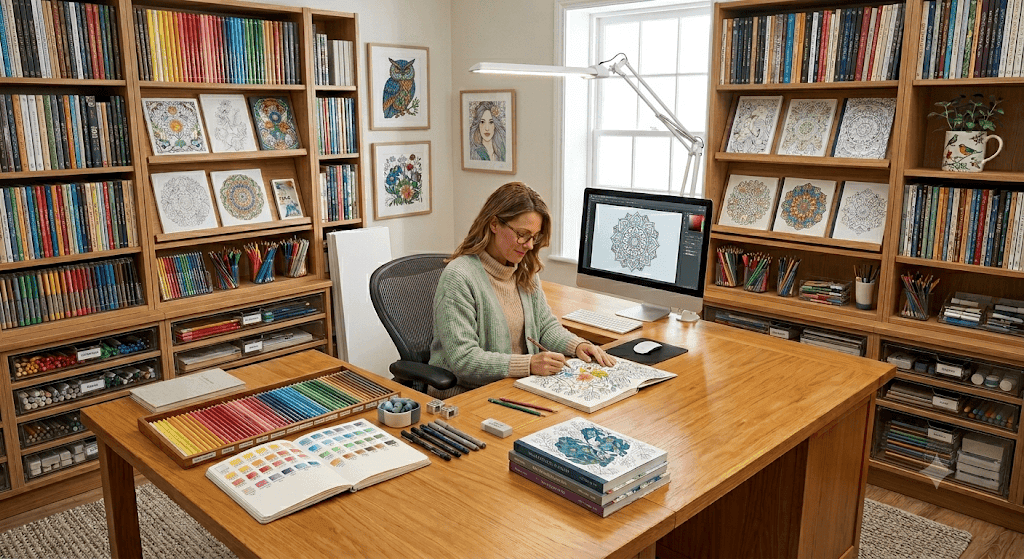
Adult coloring is one of those hobbies that sneaks up on you. You start with one book and a basic set of pencils, and before long you’re reorganising your collection by hue at 11pm and calling it self-care. Sound familiar?
Here’s what I find interesting: there’s a real reason it takes hold so fast. Your brain is getting something it genuinely wants, and once it knows where to find it, it keeps coming back.
Why Adult Coloring Gets Under Your Skin
Flow state is the big one. When you’re coloring, your brain gets absorbed enough to push out the background noise, but the task isn’t so demanding that it tips into stress. Time drops away. That state is genuinely addictive, and coloring is unusually good at producing it.
Every section you finish also triggers a small dopamine hit — the brain’s reward signal. One finished petal, one corner of sky. A tiny jolt of satisfaction, and your brain files it away for next time.
The repetitive motion of shading and blending activates your parasympathetic nervous system — your body’s physical calming response. Heart rate slows. Cortisol drops. A lot of colorists say it’s the most reliable stress relief they’ve found, and the physiology backs that up.
There’s no blank canvas here either. The design is already drawn, which takes the anxiety of starting something from scratch completely off the table. You get the creative satisfaction without the creative pressure.
And picking up pencils and paper is just different from screens. The feel of pencil on paper, the texture under your hands — it’s a physical experience that nothing digital quite matches.
The Signs Are Probably Familiar
Every colorist has a moment when they realise the hobby has properly taken hold. Here are a few you might recognise.
- 1 You go out to buy bread and milk — and somehow a new coloring book and a set of fine-liners follow you home. The bread and milk did not.
- 2 You decide that this month you’re prepared to skip a few meals if it means getting that gorgeous new set of Polychromos off Amazon.
- 3 You’re finishing “just one more section” and it’s suddenly 4am. You have work in three hours. The page does look amazing, though.
- 4 Your spare room (or corner of the living room, or dedicated drawer, or dedicated cabinet) looks like a stationery store. You can account for every single item in it.
- 5 You see someone wearing a black-and-white patterned dress and your first thought is: “I could do that with my fine-tip markers — warm palette for the top half, cool tones below…”
- 6 You’ve spent 45 minutes sorting your pencils by hue and called it a productive afternoon. You stand by this.
- 7 You have 200 colored pencils and are genuinely considering whether you have enough coverage in the yellow-greens.
- 8 You’ve watched three YouTube reviews of a set of pencils you already own. You found something new to appreciate each time.
- 9 Packing for a holiday involves careful consideration of which coloring book to bring. You end up packing two, just in case.
- 10 You have opinions about paper. Real opinions. You’ve turned down coloring books because the paper wasn’t heavy enough.
- 11 You’ve rearranged other commitments to protect coloring time. You don’t feel remotely guilty about this.
- 12 You bought someone a coloring-related gift. They don’t color. You thought it might get them started. They haven’t started. You’re still hopeful.
When the Books Aren’t Enough
Once coloring really takes hold, the books stop being enough on their own. You start noticing colorable potential in things you’d never have looked twice at before — and the market has definitely noticed. There’s a whole range of items designed for exactly this kind of creative extension.
🏠 Home & Lifestyle
Color-it-yourself mugs, placemats, tablecloths, coasters, cushion covers, wall art. Your home, your palette.
👕 Wearables
T-shirts, tote bags, sneakers, and scarves with black-and-white patterns ready for fabric markers. Wear what you color.
🎨 Creative Projects
Mandala designs on river stones and pebbles, color-your-own puzzles that reveal the full image as you go.
📱 Everyday Objects
Phone cases, notebooks, ceramic plant pots, even pet accessories. If it has a surface and a pattern, it’s fair game.
🪨 Rock & Stone Art
Mandala designs painted onto smooth river stones. Same meditative focus as a coloring book, except the finished piece is something you can display or give away.
The appeal is the same as it is with coloring books. You get the satisfaction of making something, the focus of the process, and a finished piece you can actually use.
Looking for specific product ideas, whether you’re treating yourself or shopping for another colorist? The Gifts Guide has 26 ideas across these exact categories, with real product picks for every budget.
See the Gifts for the Addicted Colorist guide →More for the Addicted Colorist
🎁 Gifts for Colorists
26 gift ideas for the adult colorist in your life, from stocking fillers to proper splurges. Supplies, colorable home goods, wearables, and creative projects all covered.
Explore Gift Ideas →🛡️ Health & Safety
How to set up for long sessions without the aches. Ergonomics, eye strain, hand and wrist care, and what ACMI certification actually means for your supplies.
Read the Health & Safety Guide →🎨 Techniques & Tips
Blending, shading, backgrounds, color theory. Step-by-step guides for all of it — the skills that make a real difference to how your finished pages look.
Browse Techniques →You’re Not Alone in This
Adult coloring attracts one of the most welcoming communities in any creative hobby. Some of that is because it’s non-competitive, but a lot of it is just that everyone in a coloring group immediately recognises “that person with 300 pencils.” There’s no explaining yourself.
Reddit’s r/Coloring and r/ColoringBooks are both worth checking out, and Facebook groups like Adult Coloring Worldwide are genuinely active. YouTube has a dedicated community of colorists sharing time-lapses and product reviews with real generosity. If you haven’t found your coloring community yet, it tends to find you once you start talking about it.
And if you’re just getting started — or wondering whether you’re ready to move beyond your current supplies — the Techniques section is a good place to begin, along with our guides to coloured pencils and markers.
Frequently Asked Questions
Frequently Asked Questions
Click any question to expand the answer.
That’s flow state. Coloring is unusually good at triggering it because the task sits at just the right level of difficulty — absorbing enough to push out background noise, but not so demanding that your brain starts fighting it. The design is already drawn; you just color it. Most people slip into that state faster here than with almost anything else they try, which is probably why the habit forms so quickly.
Nobody’s going to draw that line here, and we’re certainly not going to be the first. A collection of unfinished coloring books is just an inspiration library in progress. The goal was never to finish every page in every book. It’s the experience of each session that matters. Buy accordingly.
Because “plenty” is a relative term in the coloring community, for one thing. And because the same dopamine system that makes coloring enjoyable also responds to anticipation — the idea of a new set gives you a small reward before you’ve even opened the box. That’s the mechanism behind any collection hobby.
Here’s the honest question to ask yourself: will these supplies actually improve what you’re making? If yes, that’s a reasonable call. If the real satisfaction is in the box arriving, it’s worth being honest about that too.
More options than most colorists use. Framing a favourite is the most satisfying — properly framed, a finished coloring page looks genuinely good on a wall. For multiple pages, a gallery wall works well. Clear-pocket binders kept flat will preserve them if you’re not displaying them yet. Scanning before you cut anything out of the book gives you a digital copy you can reprint or share whenever you want.
Finished pages also make surprisingly personal gifts. A piece you’ve colored from a book the recipient loves means more than most store-bought cards. Some colorists use them as wrapping paper when giving gifts to fellow colorists.
What most people regret: leaving a finished page in a closed book where nobody ever sees it. Including you.
Completely normal, and very common. The unstarted pile is almost universal among dedicated colorists — books set aside for a mood or season you haven’t hit yet, or a medium you’re saving for the right moment. Options, not failures.
The only time it matters is if the guilt about them starts outweighing the pleasure of having them. If that happens, donating a few to a library or coloring group is a perfectly good reset. Unstarted books don’t need fixing.
One of the most talked-about topics in coloring communities, which tells you it’s genuinely hard. Go by mood first. Detailed books suit focused days. More open designs suit tired ones. Or pick by palette: look at the colors you feel like using right now, then find the book that suits them rather than trying to choose the book outright.
Flipping through your collection without a plan and stopping at the first page that catches you is surprisingly effective. Some colorists run two or three books at once, which removes the commitment pressure altogether. And if the decision is stressing you out, that’s already an answer: grab the simplest book you own and start.
Yes, and a lot of colorists find the second pass more satisfying than the first. Your skills are different, your pencils might be different, and you bring a completely different mood to the same page. The result is genuinely different work from the same design.
Some colorists go back to the same books every few years specifically to see how their technique has moved on. That kind of comparison is more honest than most people expect.
One practical thing: if you’re planning to revisit a book, scan or photocopy the pages before you color them the first time. Clean version on hand, no need to buy a second copy.
Check whether it’s the hobby or just the setup, first. Switching medium can do more than you’d expect: if you’ve been using pencils for a while, one session with alcohol markers feels like a completely different activity. Going in the opposite direction works just as well.
A style change helps too. If your recent books have been very detailed, try something with bigger, looser spaces to fill. If you’ve been coloring alone, a group session — live or online — changes the energy quite a bit.
A lot of what feels like staleness is just a signal you’re ready for something more challenging. The Techniques section has guides on blending, shading, and backgrounds — exactly the kind of skills that make your existing books feel new again.